

Hey Friends 👋 Happy Thursday
Here’s another weekly dose of AI ways of working.
You have been sitting on a product idea for months.
You know exactly what it needs to do. You have mapped out the user journey, written the requirements, and identified the bottlenecks. But every time you think about building it, you hit the same wall: your time is better spent running the business than learning to code.
So you hire one. Or you try to explain your vision to a developer. Or you spend three hours in a ChatGPT rabbit hole and ship nothing.
Here is the thing nobody is telling you: the person who understands the problem is more valuable than the person who writes the code. That gap is now closed.
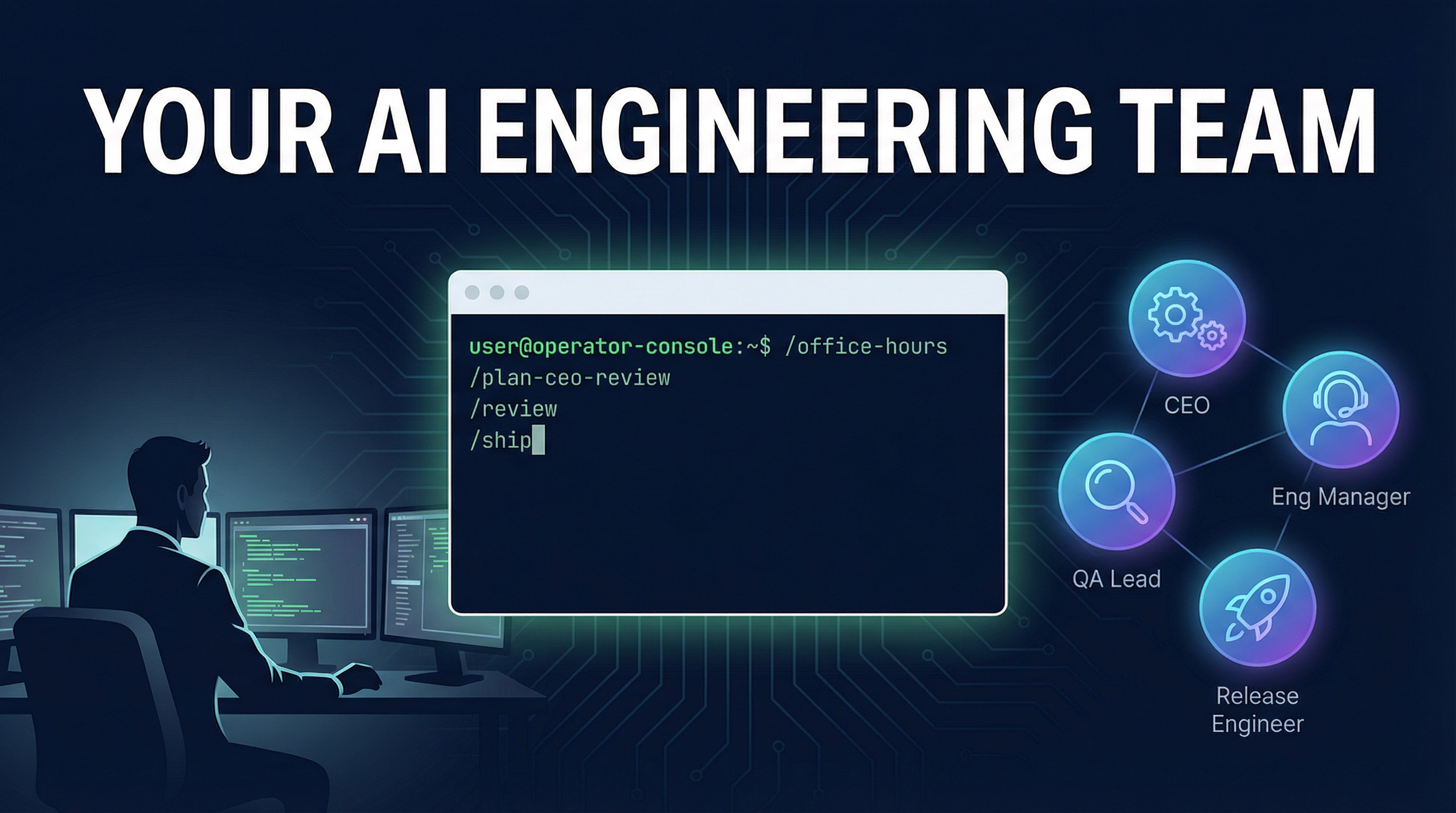
Garry Tan, the CEO of Y Combinator, the organisation that backed Airbnb, Stripe, and Coinbase, just open-sourced his personal Claude Code setup. He calls it gstack. According to Tan, in the past 60 days using this exact framework, he wrote over 600,000 lines of production code while running YC full-time (35% of which are tests). The repository accumulated over 33,000 stars on GitHub within a week of launch — one of the fastest-growing open-source repositories of 2026.
This is your new operator playbook.
Why Claude Code (Not ChatGPT)
Most operators start with ChatGPT. It is familiar. But there is a fundamental limitation: ChatGPT cannot act inside your operating environment. You feed it information, it generates text, and you copy-paste the result.
Claude Code is different. It operates directly inside your terminal, your operating environment, where all your context lives. It reads your files, runs your tests, and pushes your code. It does not wait for you to copy-paste anything.
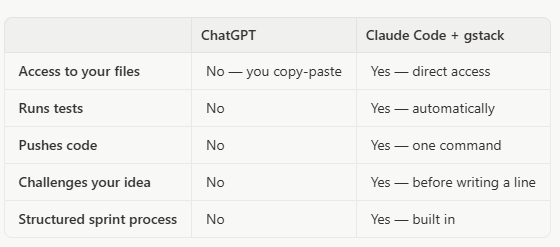
The distinction matters. ChatGPT is a writing tool. Claude Code is an operating tool.
What gstack Actually Is
gstack is not a collection of prompts. It is a structured operating model, a sprint framework that forces you to move through a disciplined process before a single line of code is written.
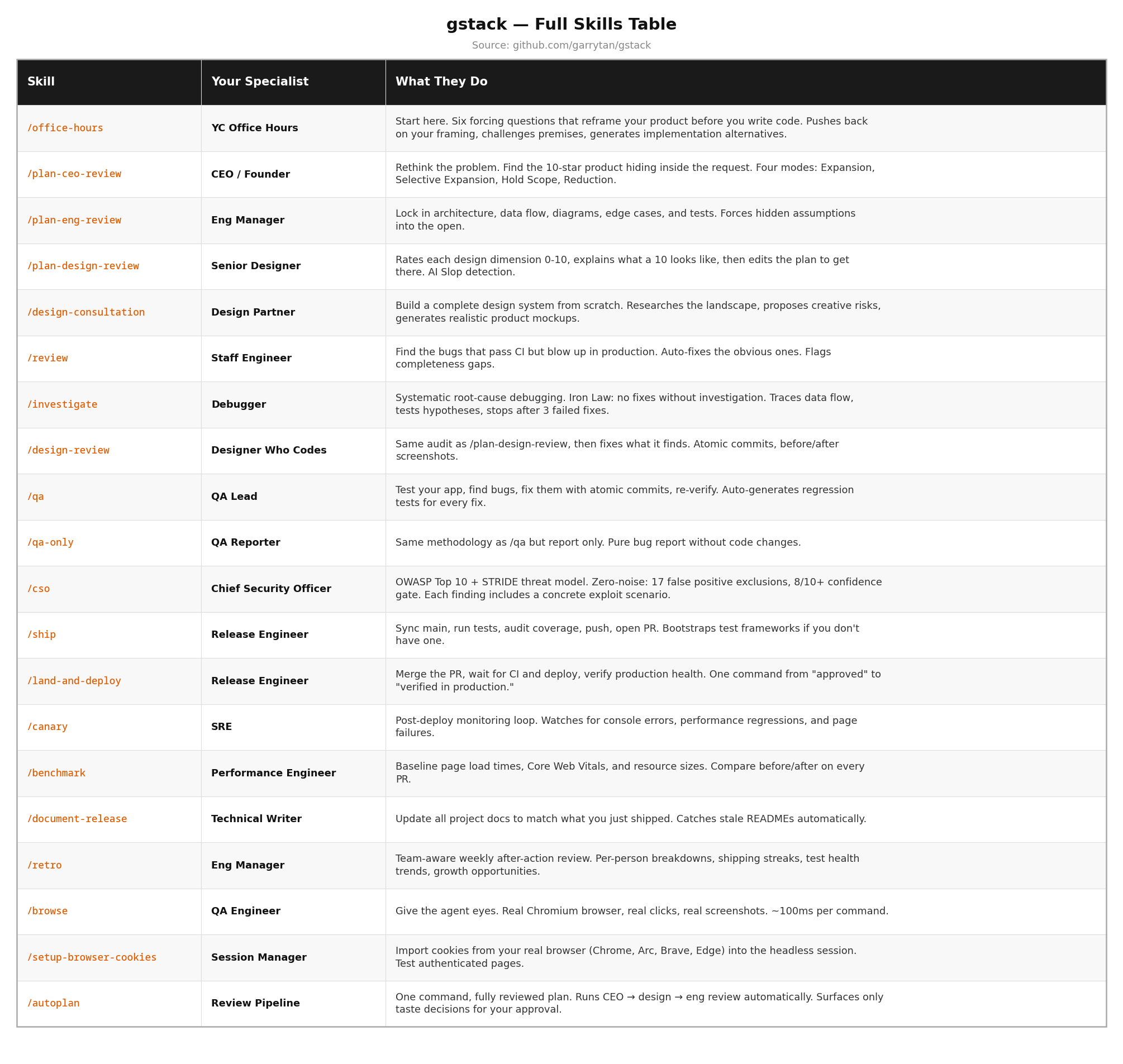
The framework gives Claude Code a team of specialist roles and tools, each activated by a simple slash command. You are not writing software. You are managing a digital employee. That is what operators do.
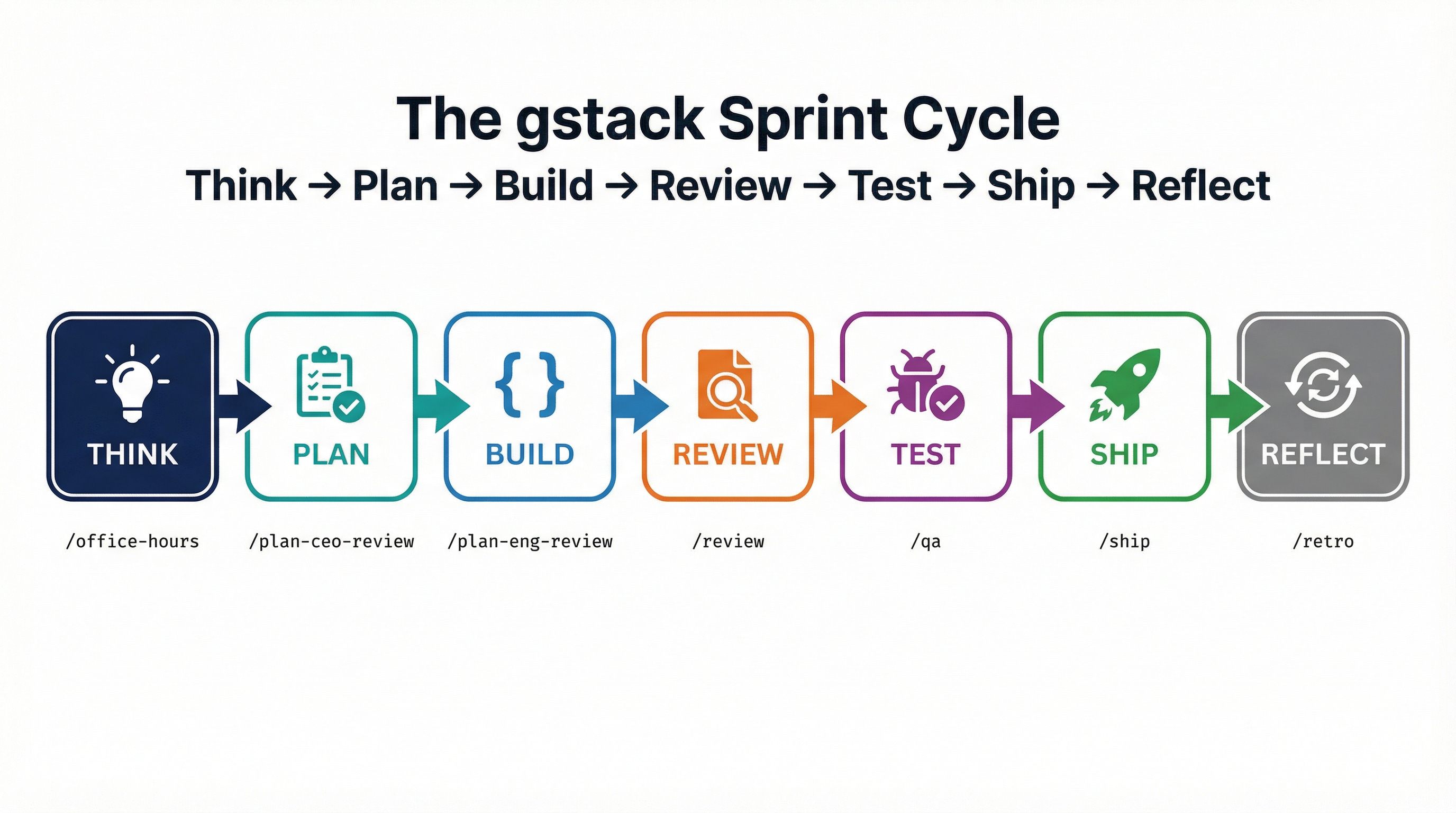
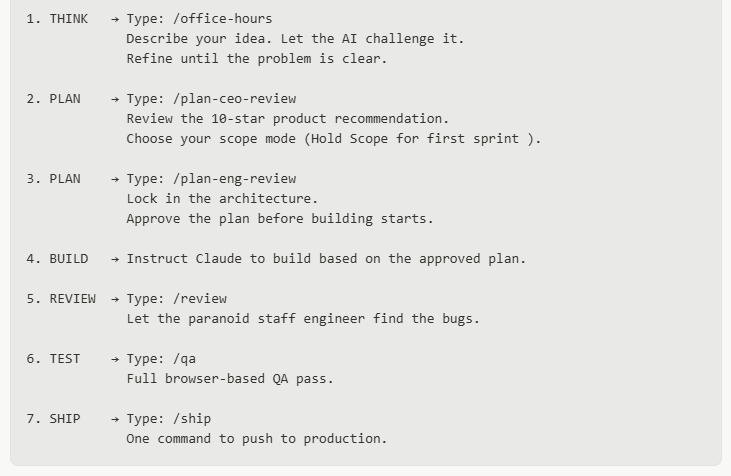
The build cycle runs in a specific order. Each step feeds the next. Nothing falls through the cracks.
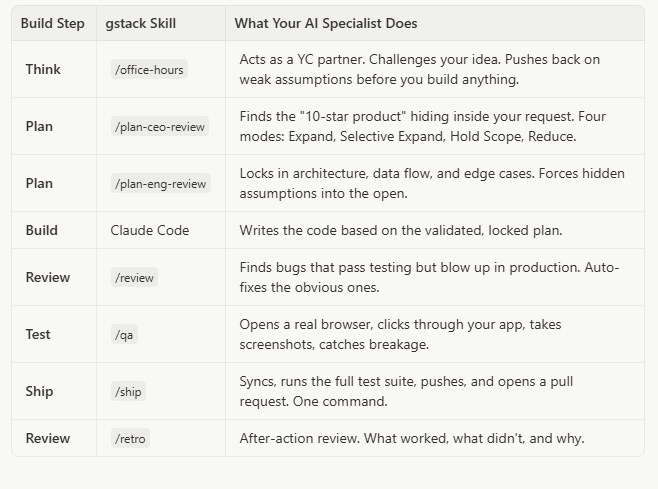
The /office-hours skill alone is worth the setup. It encodes how YC partners actually pressure-test startup ideas, the same questions they ask founders sitting across from them in Mountain View. You get that thinking applied to your idea before you spend a single hour building.
What You Will Build
You will build a structured operating process that transforms Claude Code from a blank prompt into a virtual engineering team.
•Time to set up: 5 minutes
•Time per build cycle: Under 30 minutes for a complete feature
•What you ship: Validated, tested, production-ready code
Step 1: Install gstack (5 Minutes)
What you need:
•Claude Code installed on your machine (download here)
•A terminal (Mac: Terminal or iTerm; Windows: PowerShell)
How to do it:
Step 1. Open your terminal.
Step 2. Run this single command:
git clone https://github.com/garrytan/gstack.git ~/.claude/skills/gstack && cd ~/.claude/skills/gstack && ./setup
Step 3. Restart Claude Code.
That is it. Claude Code now has access to all gstack specialist roles.
Operator Note: You are giving Claude Code a set of “skills.” Think of it as onboarding a new team of specialists on their first day. You are not writing code, you are setting up your operating environment.
Step 2: Run Your First Build Cycle
Open Claude Code and follow this process:
Adjust the cycle:
•For your first build, use “Hold Scope” mode in /plan-ceo-review to keep the scope tight.
•Replace the idea description in /office-hours with your specific business problem.
•Run /retro at the end of each week for an after-action review of what shipped.
Step 3: Review the Output
After /office-hours, you will receive a structured critique of your idea with three implementation alternatives. This is not generic AI output. The skill encodes the actual methodology YC partners use to evaluate startups.
Review the output. If the AI is pushing back on your framing, that is the point. A bad idea caught at the thinking stage costs you nothing. A bad idea caught after three weeks of development costs you everything.
What You Have Built
You have built a structured operating model for AI-assisted software development.
How software was being built before:
Write a lengthy PRD: 60 minutes
Hand off to engineering: Days
Wait for QA: 90 minutes
Review and revise: More days
Total: Weeks
Now with Claude Code + gstack:
Agent challenges and validates the idea
Review the architecture in 5 minutes
Agent builds, tests, and ships
Total: Under an hour
Monthly impact (4 builds): 16 hours back and four features shipped that would have sat waiting for a developer.
What You Just Learned: Context Engineering
You did not just automate a task. You learned context engineering, the most important skill for operators in the AI era.
Old way of running a team:
You wrote requirements
You delegated to humans
You followed up manually
You waited for delivery
New way of running a team:
You structure context (what the agent needs to know)
You delegate to AI agents
You review outputs
You ship in the same session
The skill is the same: breaking down what needs to happen and communicating it clearly. The tool changed. The management thinking did not.
This is why operators are beating developers right now.
Developers are trained to obsess over syntax. They spend hours arguing about the perfect way to write a function or format a database query. But AI already knows the syntax. The bottleneck is no longer writing the code, the bottleneck is deciding what to build and how to sequence the work.
Operators know process. You know how to take an ambiguous business goal, break it down into requirements, assign roles, review the output, and push it live. You do this every day with human teams.
With gstack, you are simply applying that exact same operating playbook to a team of AI agents. In the age of AI, how you run the work is the competitive edge.
What to Build Next
Once you have run your first build cycle, one thing to add immediately:
Automate your after-action reviews. The /retro skill analyses your commit history and generates a weekly review: what shipped, what didn’t, and why. Run it every Friday.
Note: The gstack repository also includes /browse for browser-based QA and /canary for post-deploy monitoring. Both exist in the live repo, I haven't finished testing either yet, so I'll cover them properly once I have. That's my bar for writing about something.
The Bigger Picture
Garry Tan claims to have written 600,000 lines of code in 60 days (35% of which are tests). He is not a better developer than you. He is a better operator. He built a structured process, gave his AI agents clear roles, and managed the work like someone who knows how to get things shipped.
The developers who are struggling with AI tools are the ones who treat Claude Code like a smarter autocomplete. The operators who are winning are the ones who treat it like a team.
gstack is free. It is open source. And it is the closest thing to a YC-endorsed operating model for AI-assisted development that exists right now.
Your move.
Subscribe for more AI systems for operators →
References
[2] TechCrunch — “Why Garry Tan’s Claude Code setup has gotten so much love, and hate”:
[3] Garry Tan on X — gstack announcement:
[4] Medium — “gstack is not a dev tool. it’s Garry Tan’s brain on AI”: